When a business provides products or services on credit, unpaid invoices are an unavoidable risk. Even reliable customers can experience cash-flow problems, administrative delays, disputes, or changing financial circumstances that cause payments to become overdue.
The real question for a business is not whether unpaid accounts will occur, but how effectively those accounts can be recovered.
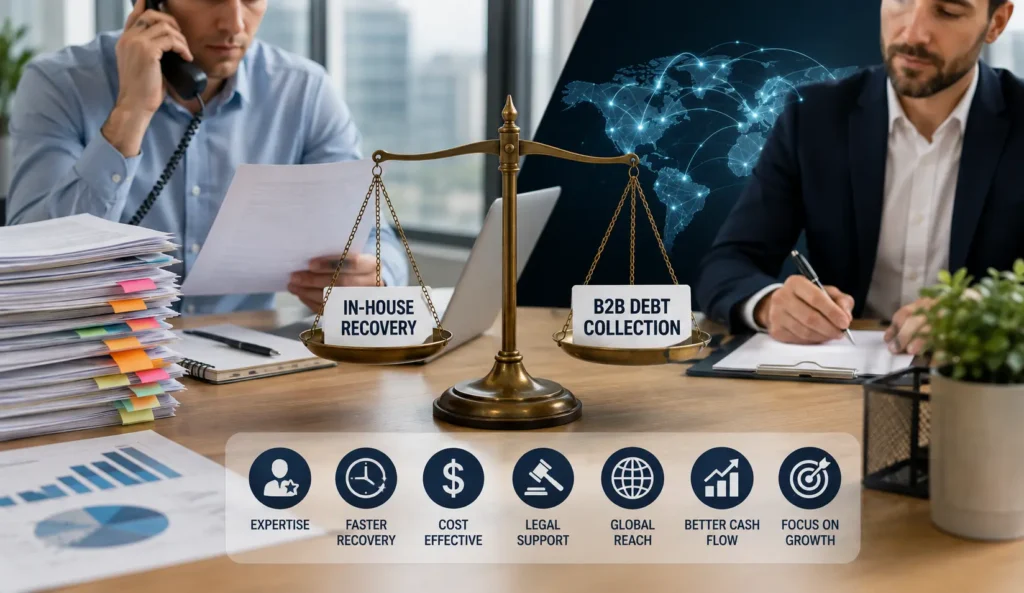
When invoices become seriously overdue, companies generally have two choices: manage the recovery process internally or work with a professional B2B debt collection company.
Both approaches have advantages. In-house recovery can provide direct control over customer relationships, while professional commercial debt collection can provide specialized expertise, dedicated resources, structured processes, and escalation options that may not be available to an internal accounting team.
For many businesses, the right choice depends on the size of the outstanding balance, the age of the debt, the number of delinquent accounts, internal resources, customer relationships, and the complexity of the recovery process.
This guide compares B2B debt collection with in-house recovery to help businesses determine which approach may be more effective for their circumstances.
B2B debt collection refers to the process of recovering money owed between businesses.
Unlike consumer debt collection, B2B recovery generally involves commercial transactions between companies. These may include unpaid invoices for:
Commercial debts can sometimes involve complex documentation, including contracts, purchase orders, delivery records, invoices, service agreements, change orders, and account statements.
A professional collection provider evaluates the available documentation, contacts the debtor, negotiates payment where appropriate, and may pursue additional recovery options when ordinary collection efforts are unsuccessful.
In-house recovery means that the company’s own employees handle overdue accounts.
Typically, accounts receivable staff or finance employees are responsible for:
For businesses with a small number of overdue invoices, this can be a practical solution.
However, as the volume or complexity of overdue accounts increases, internal recovery can consume substantial time and resources.
The primary difference between these two approaches is specialization.
An internal accounting employee may spend part of their working day managing collections alongside invoicing, bookkeeping, reporting, and other financial responsibilities.
A professional debt recovery agency, on the other hand, focuses specifically on recovering outstanding debts.
Here are some of the most important differences.
One of the biggest advantages of professional B2B debt collection is specialized experience.
Internal employees may understand the company’s products, customers, and contracts very well, but they may not have extensive experience handling difficult commercial debtors.
A professional collection team typically deals with overdue accounts regularly and can recognize different types of recovery situations.
For example, a debtor may be:
Each situation can require a different strategy.
Professional recovery specialists can evaluate the circumstances and determine an appropriate course of action.
In-house collections can become expensive even when employees are not specifically classified as collection specialists.
Consider how much time employees spend:
If employees spend several hours each week chasing overdue accounts, that time comes with an opportunity cost.
Those employees could otherwise focus on:
Outsourced collections can shift much of this workload to a specialized external team.
Cost is one of the most important factors when deciding between internal and external recovery.
In-house recovery can appear less expensive because the business is not paying an outside collection company.
However, there are hidden costs.
These may include:
Professional collection services introduce a direct recovery cost, but businesses may only incur that cost when the agency successfully recovers funds, depending on the provider and service agreement.
For example, a contingency-based recovery model can align the collection provider’s compensation with the outcome.
Businesses should compare the total cost of internal recovery against the potential recovery results rather than looking only at the agency’s fee.
Time matters when dealing with commercial debt.
An invoice that is only a few days overdue may be relatively easy to recover. However, an account that remains unpaid for many months may become increasingly difficult to resolve.
Internal teams sometimes struggle to maintain consistent follow-up because collections are only one of many responsibilities.
Professional commercial debt collection teams are specifically structured to pursue overdue accounts.
A defined process can help move an account from:
Invoice → Reminder → Follow-Up → Negotiation → Escalation → Recovery
without leaving the account inactive for extended periods.
Some businesses worry that using a third-party collection company could damage customer relationships.
This concern is understandable, particularly when the debtor is a long-term customer.
However, the alternative can also damage the relationship.
Repeated collection calls from an internal employee who works closely with the customer can create uncomfortable interactions.
A professional third-party recovery specialist can provide some separation between the commercial relationship and the payment dispute.
Professional communication can focus on resolving the outstanding balance while maintaining a respectful tone.
In some situations, outsourcing the recovery process can actually help preserve the company’s internal relationship with the customer.
Not every overdue invoice can be recovered through emails and phone calls.
Some debtors may dispute the account, refuse to communicate, or continue delaying payment despite repeated requests.
In those situations, businesses may need additional escalation options.
A professional debt recovery agency may have access to legal professionals and established recovery networks that an internal accounting department does not have.
Legal escalation can potentially include:
Legal action is not necessarily appropriate for every account. The decision depends on the amount owed, documentation, jurisdiction, debtor circumstances, and potential recovery value.
Having access to appropriate legal resources nevertheless gives businesses more options when standard collection efforts fail.
International debt collection can be particularly challenging for internal teams.
A business may have a customer located in another country, creating additional considerations involving:
A professional collection provider with international capabilities can help businesses navigate these complexities.
This can be particularly useful for manufacturers, exporters, logistics companies, technology businesses, wholesalers, and other organizations that serve international customers.
In-house collection can vary depending on which employee handles an account.
One employee might make frequent follow-up calls, while another may send an email once every few weeks.
A professional collection process can provide greater consistency.
Accounts can be categorized based on factors such as:
This allows recovery strategies to be applied systematically.
Consistency is particularly important for businesses with a large number of overdue invoices.
Professional collections are not necessarily the right choice for every overdue invoice.
In-house recovery can work well when:
For example, if an otherwise reliable customer is five days late because an invoice was sent to the wrong billing department, there may be little reason to involve an external recovery company.
Internal communication may resolve the problem quickly.
Outsourced collections become increasingly attractive when accounts require significant time, expertise, or escalation.
Businesses may want to consider professional B2B recovery when:
The decision should not be based solely on how old the debt is.
The likelihood of recovery, value of the account, documentation, customer relationship, and potential legal considerations should also be evaluated.
Businesses do not necessarily have to choose between completely internal collections and completely outsourced recovery.
A hybrid approach can often provide the best balance.
For example:
The company handles normal invoice follow-up.
A manager becomes involved when an invoice reaches a certain age.
Accounts that remain unresolved are referred to a professional B2B collection specialist.
Cases that cannot be resolved through ordinary collection efforts may be evaluated for appropriate legal action.
This allows internal teams to manage routine accounts while reserving professional recovery services for more challenging debts.
Before choosing a recovery strategy, ask the following questions.
A $500 overdue invoice and a $100,000 commercial debt may require very different strategies.
Evaluate the potential recovery against the cost and effort required.
Older accounts may require more aggressive or specialized recovery efforts.
Review your aging report regularly.
One overdue customer may be manageable internally.
Hundreds of overdue accounts can quickly overwhelm an internal team.
Calculate the actual labor involved.
If employees spend dozens of hours every month chasing debt, outsourcing may become financially attractive.
A genuine contractual dispute may require investigation before collection efforts can proceed.
Out-of-state or international accounts may require additional expertise.
If your internal team has no practical way to escalate a difficult account, working with a provider that has legal resources may be beneficial.
Hawthorne Cole Meridian LLC provides commercial debt recovery solutions designed to help US businesses recover outstanding B2B balances.
Its services include:
The company’s recovery process begins with claim submission and debt investigation. Recovery specialists then contact debtors and negotiate payment. Where appropriate, matters can be escalated through mediation or legal channels.
Hawthorne Cole Meridian also offers a no-recovery-no-fee model for qualifying recovery services, allowing businesses to pursue commercial debt without the same upfront financial commitment associated with building an extensive internal recovery operation.
The company states that it has served more than 5,000 clients, recovered more than $500 million, and has experience spanning more than 25 years.
Its network also supports recovery efforts across the United States and internationally.
For companies with difficult commercial accounts, this type of specialized infrastructure can provide an alternative to relying entirely on internal accounts receivable staff.
Choosing a professional debt recovery agency can provide several potential benefits.
A professional team focuses specifically on debt recovery rather than balancing collections with unrelated accounting responsibilities.
Experienced recovery specialists understand how to communicate with commercial debtors and negotiate practical payment solutions.
Professional recovery programs can provide clear steps from claim submission through resolution.
When appropriate, legal professionals may be available for escalation.
Businesses with international debtors may benefit from access to recovery specialists in different jurisdictions.
Employees can focus on core business responsibilities instead of spending large amounts of time chasing overdue accounts.
Businesses can maintain visibility into the status and progress of recovery cases.
If you decide that professional collection support is appropriate, evaluate potential providers carefully.
Look for:
Commercial experience: Choose a provider familiar with B2B accounts rather than one focused exclusively on consumer debt.
Transparent pricing: Understand how fees are calculated and when they become payable.
Compliance: Confirm that collection practices follow applicable laws and regulations.
Communication: Ask how often your company will receive updates.
Legal capabilities: Determine whether legal escalation is available when appropriate.
International support: If you have overseas debtors, confirm the provider’s international capabilities.
Technology: Case tracking and digital documentation can make the process easier to monitor.
Dedicated support: Having a specific recovery specialist or account contact can improve communication.
One of the biggest mistakes companies make is allowing overdue accounts to remain untouched for too long.
The assumption may be that the customer will eventually pay.
Sometimes they do.
But delays can become habitual. A customer who learns that payment can be postponed for months may have little incentive to change their behavior.
Meanwhile, the business continues carrying the receivable on its books.
A structured escalation policy ensures that every overdue account receives an appropriate level of attention.
The objective is not to immediately outsource every late invoice.
Instead, businesses should know exactly when an account has reached the point where professional recovery is worth considering.
So, which is better?
The answer depends on the circumstances.
In-house recovery can be effective for routine overdue invoices, minor payment delays, and customers with strong payment histories. It allows businesses to maintain direct control over communication and can resolve simple issues quickly.
However, B2B debt collection becomes increasingly valuable when debts are older, larger, disputed, difficult to recover, or consuming too much internal time.
For many businesses, the strongest approach is a combination of both.
Handle ordinary accounts internally. Establish clear escalation points. When an account becomes seriously overdue or internal efforts stop working, refer it to a professional commercial recovery specialist.
This approach allows businesses to protect customer relationships while ensuring that difficult accounts receive the attention they require.
Ultimately, successful receivables management is not simply about sending more reminders. It is about having the right process, resources, expertise, and escalation strategy at every stage of the recovery cycle.
If your business has commercial accounts that remain unpaid despite repeated internal collection efforts, professional recovery support may be the next logical step.
Hawthorne Cole Meridian LLC helps US businesses pursue outstanding commercial debts through B2B debt collection, international recovery, legal recovery, late payment recovery, and accounts receivable services.
The company provides dedicated recovery specialists and access to a nationwide and international recovery network, helping businesses pursue difficult accounts while reducing the workload placed on internal teams.
Hawthorne Cole Meridian LLC
Phone: +1 470-251-4090
Email: info@hcmrecovery.com
If your business is carrying overdue commercial invoices, consider reviewing your internal recovery process and determining whether professional outsourced collections could improve your recovery efforts and free your team to focus on growing the business.
 Guide
Guide
Late payments remain one of the biggest challenges facing businesses in 2026. A company can…
 Guide
Guide
Unpaid invoices can quickly become more than an accounting issue. When customers or business clients…
 Guide
Guide
Cash flow is the lifeblood of every business. Whether you operate in construction, manufacturing, healthcare,…
Submit your claim today — our specialists respond within 24 hours.
Submit a Claim →